

How to Compare Renovation Quotes in Singapore
Includes AI-generated visuals.
Read the video transcript
The cheapest renovation quote may not be the cheapest renovation. Before comparing totals, put every quote on the same scope. Match the rooms and work items. Then check dimensions, quantities, materials, thicknesses, brands, finishes, and hardware. Next, add every compulsory cost: GST, permits, protection, delivery, disposal, and cleaning. Finally, compare written variation pricing, milestone payments, timeline, warranty, and defect rectification. Align the scope. Normalise quantities. Add mandatory charges. Then compare safeguards. A vague low quote can become the expensive choice. Read the full guide and request an itemised quotation at homerenovation.com.sg
To compare renovation quotes in Singapore, first make sure every contractor is pricing the same rooms, work, quantities and material standard. Then compare exclusions, mandatory charges, GST treatment, variation rules, payment stages, timeline, warranty and the final amount payable.
Do not choose from the total price alone. A lower quote may simply contain less work, smaller allowances or more items left for later.
The 10-Minute Renovation Quote Comparison
Start with these four checks:
- Lock the scope. Give every contractor the same floor plan, room list and must-have works.
- Normalise the details. Match quantities, units, materials and assumptions line by line.
- Expose the final cost. Add mandatory charges, GST treatment, exclusions and likely optional items.
- Compare the contract protection. Review variations, milestones, timeline, warranty and rectification terms.
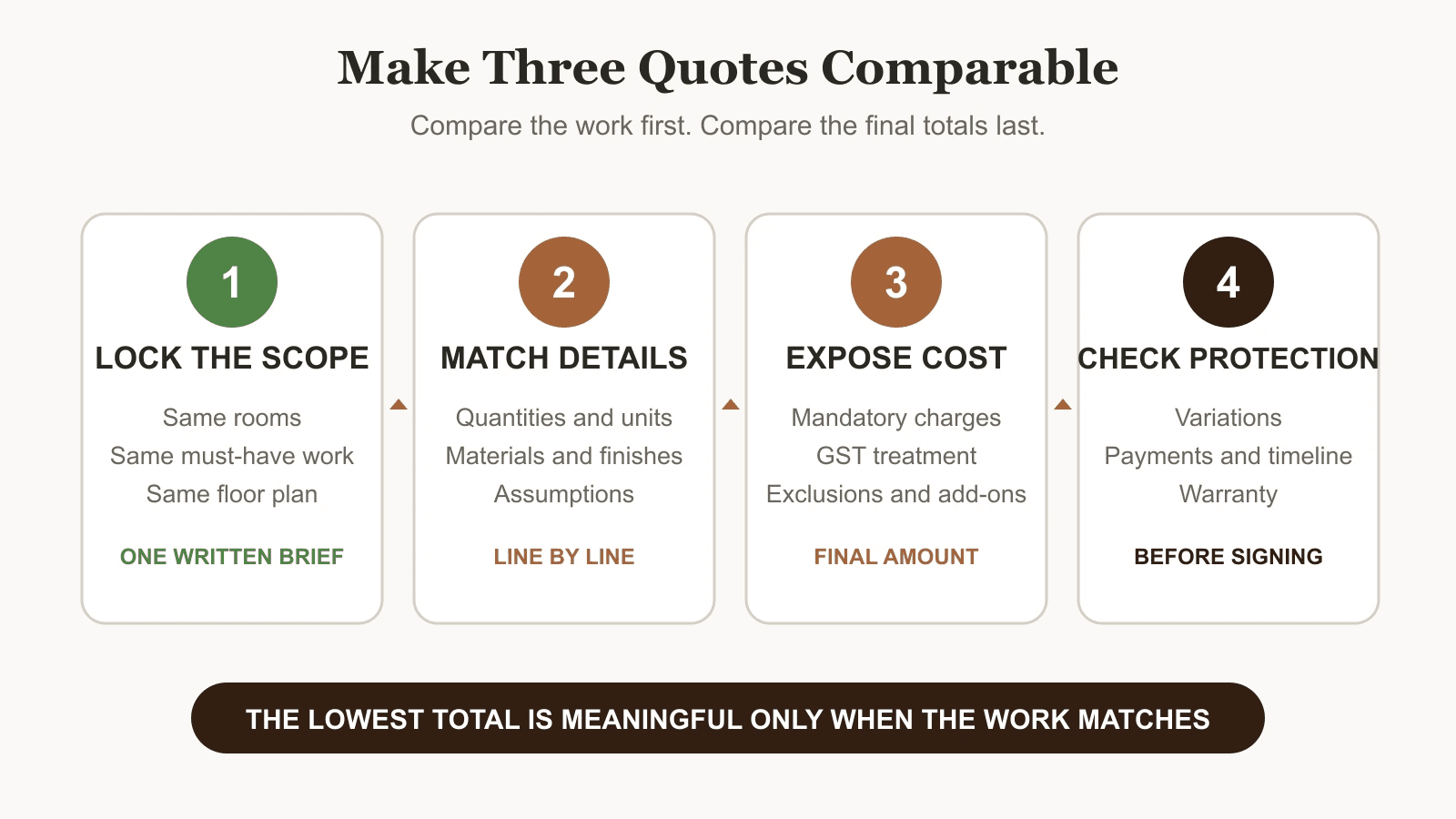
If one quote says “kitchen carpentry” and another states the cabinet length, internal finish, hardware, worktop, sink cut-out and installation method, they are not yet comparable.
What Should a Renovation Quote Include?
A useful quote should be detailed enough for another person to understand what will be supplied, installed, removed or excluded.
| Quote field | What to look for |
|---|---|
| Room and location | The exact room, wall, floor or work area |
| Work description | What will be supplied, installed, hacked, repaired, retained or protected |
| Quantity and unit | Square feet, linear feet, points, units or another measurable allowance |
| Material specification | Brand, model, thickness, finish, size or stated selection range |
| Existing condition | What is assumed to be serviceable and what remains subject to inspection |
| Inclusion | Labour, delivery, disposal, protection, cleaning and approval work where relevant |
| Exclusion | What you must buy, arrange or pay separately |
| Price | Unit rate where useful, line-item price and final amount payable |
Singapore’s Competition and Consumer Commission says renovation prices should be transparent, accurate, clear and itemised. Mandatory charges should be stated at the outset. If a charge cannot be calculated in advance, its existence and an estimate should be disclosed before the contract is signed. Read the current CCCS fair trading guidance for the renovation industry.
Compare the Same Scope, Not Just the Same Room
Put each quotation into one worksheet with one row per work item.
| Work item | Quote A | Quote B | Quote C | Question to resolve |
|---|---|---|---|---|
| Kitchen cabinets | 20 ft | 16 ft | Lump sum | Are top and bottom cabinets measured the same way? |
| Worktop | Quartz, 10 ft | Solid surface, 10 ft | Material not stated | Are the material grade, thickness and cut-outs equivalent? |
| Electrical points | 18 points | 12 points | “Electrical works” | Which points, fittings and testing are included? |
| Bathroom works | Full wall and floor scope | Floor only | Allowance | Are waterproofing, tiles, plumbing and fittings all included? |
| Disposal | Included | Excluded | Not stated | What is the final disposal charge? |
Use one of these labels for every mismatch:
- Included in all quotes
- Included in some quotes
- Different quantity or material
- Excluded
- Not stated
- Provisional or subject to inspection
Do not force a false match. If concealed pipes, wiring or substrate conditions cannot be priced before opening up the site, ask each contractor to state the assumption and how any additional work will be approved.
How to Check Materials and Allowances
“Premium”, “quality” and “standard” are not specifications. Ask for details that can be compared.
For carpentry, check board type, internal finish, external finish, hardware, dimensions and what counts as an upgrade. For tiles, check the included price range, size assumptions, laying pattern and whether levelling or special cuts cost extra. For electrical work, compare the number and type of points, switches, fittings, testing and any distribution-board work.
If a quote uses an allowance, ask:
- What product or finish can be bought within the allowance?
- Does it include delivery and installation?
- What happens if the final selection costs more or less?
- Is the contractor adding a handling or coordination charge?
An allowance is useful only when the adjustment method is clear.
Hidden-Cost Red Flags
Pause and clarify the quote if you see:
- Broad descriptions such as “general works” without quantities
- Important materials or dimensions left blank
- Mandatory electrical, plumbing, disposal or protection work omitted
- GST treatment missing from the final amount
- A low base package followed by many unavoidable add-ons
- Large provisional sums without a pricing method
- Verbal promises that do not appear in the written quote
- No written process for variations
- Payment requested before a clear work milestone
- No start date, completion target or delay process
- Warranty wording without the covered work or period
CCCS also advises contractors to describe goods and services accurately, state agreed terms in writing and obtain the consumer’s express agreement before supplying revised or additional work.
Should GST Be Included in a Renovation Quote?
The quote should state the final GST treatment clearly.
IRAS requires GST-registered businesses to display and quote GST-inclusive prices to the public. A phrase such as “prices are subject to GST” without the GST-inclusive total is not enough. See the current IRAS guidance on displaying and quoting prices.
If a contractor is not GST-registered, ask for that treatment to be stated in the quotation. In either case, compare the final amount payable, not a pre-GST figure against a nett figure.
Home Reno publishes nett package prices and states that it does not charge GST. Your tailored quotation should repeat the exact treatment so there is no ambiguity.
Check HDB, Condo and Site Requirements
The same interior scope can cost and take longer when approval, access or protection requirements differ.
For an HDB flat, confirm whether the contractor is listed in HDB’s Directory of Renovation Contractors and who will submit any required permit application. HDB’s current renovation permit guidance explains that renovation contractors submit the proposed floor plan and electronic application for work requiring approval.
For a condominium, ask for the MCST renovation pack before the quote is finalised. Compare deposits, common-area protection, lift booking, access, permitted work hours and any professional endorsement. BCA’s condo owner renovation guidance is a useful starting point.
For a landed home, separate room-level interior work from structural, roof, facade, drainage, external and authority-related work. A room package does not automatically include the professional assessment needed for a larger alteration.
Compare Variations Before You Sign
A renovation changes after signing only when the process is controlled.
The quote or contract should explain:
- Who can request a variation
- What written information must be provided
- How price and time effects are calculated
- Who must approve the change
- Whether work can start before approval
- How credits are handled when an item is removed
CaseTrust-accredited renovation businesses must use a standard renovation contract with work and payment schedules. CASE also states that pricing breakdowns should be clear and variations must be agreed in writing before the work. Review the current CaseTrust renovation-business protections.
Keep every accepted variation with the original quotation. At any point, you should be able to calculate the current approved contract sum.
Compare Payment Stages, Timeline and Warranty
The safest payment schedule follows visible progress rather than calendar dates alone.
For a CaseTrust-accredited renovation business, CASE states that payments are collected progressively at agreed milestones and the initial deposit is capped at 20 percent of the total cost. The scheme also requires a 12-month workmanship warranty, subject to the contract terms.
For any contractor, ask for:
- A projected start date and completion date
- The work attached to each payment milestone
- An inspection or sign-off point before payment
- The process for delays and homeowner-caused changes
- Handover, defect reporting and rectification steps
- The warranty period, exclusions and contact method
A higher quote can offer better value when it includes more complete scope, clearer materials, stronger coordination and better contract protection. It is not automatically better simply because it costs more.
Questions to Ask Every Renovation Contractor
Bring the same questions to each quotation meeting:
- Which rooms, quantities and materials are included?
- What is excluded or supplied by the homeowner?
- Which charges are mandatory but not yet in the total?
- Is the final amount GST-inclusive, or is GST not chargeable?
- Which items depend on site opening or final measurement?
- How are variations priced and approved?
- Who handles HDB, MCST or other submissions?
- What are the start date, completion target and main dependencies?
- What payment is due at each milestone?
- What warranty and defect rectification are included?
If the answer stays verbal, ask for it to be added to the quotation or contract.
Frequently Asked Questions
What should I look for when comparing renovation quotes in Singapore?
Compare scope, quantities, materials, exclusions, mandatory charges, GST treatment, variations, payment stages, timeline and warranty. The final totals matter only after those details are aligned.
How many renovation quotes should I get?
Get enough quotes to see whether the scope and pricing assumptions are consistent. For many homeowners, three detailed quotations are manageable. More quotes do not help if the brief keeps changing or the documents are too vague to compare.
Why do renovation quotes vary so much?
They may cover different rooms, quantities, materials, existing-condition assumptions, approval work and service levels. Compare each line before deciding that one contractor is simply more expensive.
How can I tell whether a quote contains hidden costs?
Look for missing mandatory work, vague descriptions, provisional sums, exclusions, absent GST treatment and add-ons that are unavoidable for the stated scope. Ask for every known charge or estimate before signing.
Is it safe to choose the cheapest renovation quote?
Only when it prices the same work and gives acceptable contract protection. A cheap quote with missing quantities, materials or mandatory charges can become the most expensive option later.
Should a renovation quote include GST?
GST-registered businesses must quote GST-inclusive prices to the public. If the contractor is not GST-registered, ask for the non-chargeable treatment to be stated. Always compare the final amount payable.
What is the difference between a quote and the renovation contract?
The quote describes the proposed scope and price. The contract should also govern obligations, payment stages, timeline, variations, warranty, delay and rectification. Make sure the final contract includes the quotation and every agreed clarification.
Make the Quotes Comparable Before You Choose
Start with one written brief, put every quote into the same comparison table and resolve every “not stated” item. The best choice is the contractor who offers a suitable scope, clear final price and workable contract protections for your home.
For wider cost planning, use the home renovation budget guide. If you are still choosing a starting scope, compare the renovation package guide.
When you are ready, request an itemised renovation quotation with your floor plan, property type, must-have rooms and expected timeline.