

Here is something no one tells you before you sign a renovation contract: the system is not built to make you whole. If your contractor takes your deposit and stops, the law gives you a set of doors to knock on, but most of them open onto a long corridor, and some open onto a wall. Knowing which is which, before anything goes wrong, is the difference between a partial recovery and a total loss.
This is the companion to our guide on why vetting your contractor is not enough in 2026. That guide is about prevention. This one is about the harder question: what can you actually do once the money is already gone, and how far does each option really get you.
Home Reno Pte Ltd is a CaseTrust and RCMA accredited renovation company in Singapore. We work on a protected deposit and a progressive payment schedule specifically so our customers never have to read a guide like this one in anger. But you should still know how the recourse system works, whoever you engage.
Quick Answer: What Do You Do If A Renovation Contractor Won’t Finish?
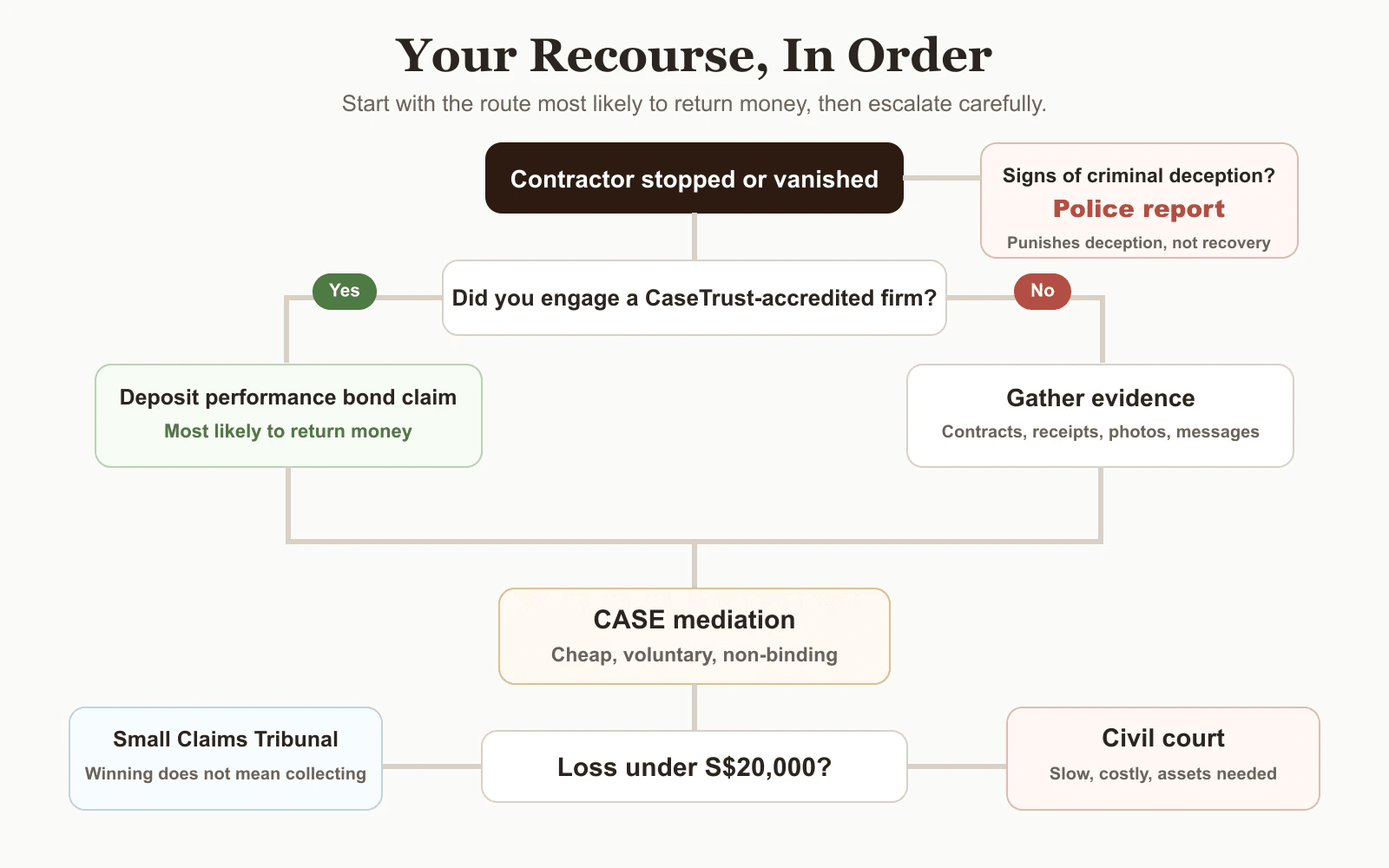
Move in this order, and stop paying immediately:
- Stop all further payment and put your concerns in writing to the firm.
- Assemble your evidence file: contract, quotes, receipts, payment records, dated site photos, and all messages.
- If you engaged a CaseTrust-accredited firm, start a deposit performance bond claim. This is the path most likely to actually return money.
- Approach CASE for mediation. It is cheap and fast but voluntary and non-binding.
- File at the Small Claims Tribunals for disputes up to S$20,000.
- Consider civil court for larger sums, and make a police report only if there are signs of criminal deception, not a simple unfinished job.
The order matters because the cheapest, most effective routes come first, and the slow, costly ones come last.
Why Recovery Is So Hard In Singapore
It helps to see the structural reasons up front, because they shape every decision below.
The tribunal has a ceiling. The Small Claims Tribunals only hear disputes up to S$20,000. Many renovation losses are larger, which drops them into an awkward gap: too big for the tribunal, too costly and slow for the civil courts. A lot of homeowners stall right there.
Winning is not the same as collecting. A tribunal order or court judgment does not move money by itself. If the firm does not pay, you have to enforce it, through a writ of seizure and sale against the firm’s assets or a garnishee order against money owed to it. Both cost more time and money, and both fail if the company has no assets. A firm with a paid-up capital of a few dollars is, by design, almost nothing to seize.
Companies can vanish legally. Some operators wind down a tainted company and reopen under a fresh registration. The debt sits with an empty shell while the people behind it keep trading.
Most disputes are civil, not criminal. Police generally cannot intervene in what is, in law, a contract dispute. They act when there is evidence of deception from the outset, which is a high bar and a different process from getting your money back.
The outcomes reflect all this. In the renovation cases CASE handled, only around four in ten reached a resolution, and of those that stalled, almost a quarter of homeowners walked away. The Government confirmed in Parliament in February 2025 that it is not introducing mandatory licensing for renovation contractors, so this framework is the one you have.
Your Options, Ranked By How Often They Work
1. The deposit performance bond claim (only if you were protected)
If you engaged a CaseTrust-accredited firm, you have the one route built to return money. The bond is designed to let you claim unused prepayments when the contractor goes bankrupt, winds up, or disappears mid-project. Contact CASE and follow the CaseTrust claim process, with your standard contract and payment records in hand. This protection only exists if you chose it before signing, which is exactly why accreditation is the centre of prevention.
2. CASE mediation
CASE can negotiate with the contractor on your behalf or mediate between you. It is inexpensive and relatively quick, and it works best when the firm is still contactable and wants to avoid escalation. The limitation is that it is voluntary and non-binding, so a contractor who has decided to disappear can simply ignore it. Use it early, while there is still a relationship to salvage.
3. The Small Claims Tribunals
For disputes up to S$20,000, the tribunal is faster and far cheaper than court, with low filing fees and no need for a lawyer. File promptly, because time limits apply, and bring your full evidence file. Be clear-eyed about the catch covered above: a tribunal order is only as good as the firm’s ability to pay it. Win, and you may still need to enforce.
4. Civil court and enforcement
For losses above the tribunal ceiling, the civil courts are the formal route, but they are slower and more expensive, often needing legal representation. Even with a judgment, you are back to enforcement through seizure of assets or a garnishee order, and back to the same question of whether the firm has anything left to take. This route makes sense when the sum is large and there are real assets behind the company.
5. A police report
Make one when there are genuine signs of criminal deception, for example a firm that took money with no intention or capacity to do the work, fake credentials, or a pattern of identical victims. The Police investigate deception, not disappointment. A report can matter where an operator has cheated many homeowners, but it is not a substitute for the civil routes to recover your specific loss.
Build Your Evidence File Before You Need It
Every route above runs on the same documents. Keep them from day one, not from the day things go wrong:
- The signed contract and the original itemised quote
- Official receipts for every payment, made out to the company
- Bank or cheque records showing money went to the company, not an individual
- Dated photos at each stage, especially before each progressive payment
- All correspondence: messages, emails, and notes of phone calls and site visits
This file is also the quiet argument for doing prevention properly. The same habits that protect you during the job, paying the company through traceable means, staging payments against verified work, keeping receipts, are the habits that give you a case if you ever need one.
The Real Lesson
Read back through the options and the pattern is hard to miss: the one route that reliably returns money is the deposit bond, and you can only use it if you set it up before signing. Every other path is slower, costlier, or dependent on a firm that may have nothing left. That is not a reason for despair. It is the clearest possible argument for spending your energy on prevention, which we lay out in full in why vetting your contractor is not enough in 2026.
If you would rather not test this system at all, that is the entire point of an accredited firm on a protected deposit and progressive payment. Start from our renovation packages or request an itemised quote.
Frequently Asked Questions
Can I get my money back if my renovation contractor does not finish?
Sometimes, but often only partially. The most reliable route is a CaseTrust deposit performance bond claim, which only exists if you engaged an accredited firm. Otherwise you are relying on CASE mediation, the Small Claims Tribunal for sums up to S$20,000, or civil court, all of which depend on the firm still having assets to pay you.
Is a renovation dispute a criminal or civil matter in Singapore?
Usually civil. An unfinished or defective renovation is a contract dispute, which the Police generally cannot act on. It becomes a criminal matter only where there is evidence of deception, such as taking payment with no intention or ability to do the work. The two are separate processes: criminal investigation punishes the wrongdoer, civil action recovers your loss.
How much does the Small Claims Tribunal cover and cost?
The Small Claims Tribunals hear disputes up to S$20,000, with low filing fees and no lawyers required, which makes it far cheaper than court. The limitation is enforcement: if you win but the contractor does not pay, you must take further steps to seize assets or garnish money owed to the firm, and those fail if the company has nothing.
Will the police help with a renovation dispute?
Only where there are signs of criminal deception rather than a contract gone wrong. If a contractor cheated many homeowners through a clear pattern of deception, a police report matters. For recovering your own money on an unfinished job, the civil routes through CASE, the tribunal, or court are the relevant ones.
What is a deposit performance bond?
It is a protection that CaseTrust-accredited renovation firms are required to maintain. It is designed to let you claim back unused prepayments if the firm goes bankrupt, winds up, or disappears before the work is done. It is the single recovery mechanism that does not depend on chasing a firm that may already be empty, which is why it is worth choosing an accredited contractor before you sign anything.